Suction line accumulators
Mounted on the compressor suction line, an accumulator separates liquid refrigerant that has not boiled off and returns only gas to the compressor. On low-ambient and long-line systems it is the cheapest protection against slugging.
Request a quote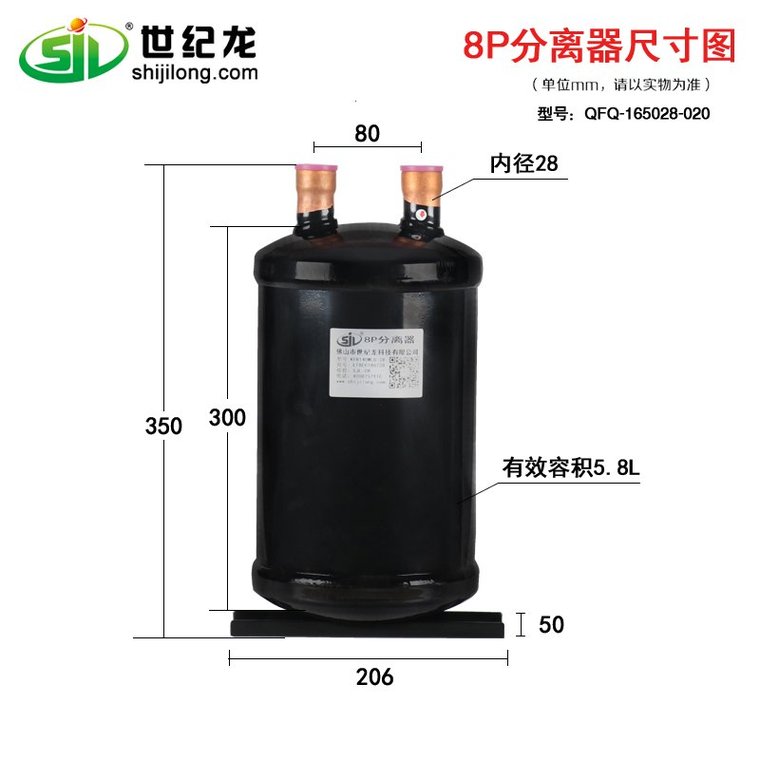
Specifications
| Standard sizes | 5 HP / 10 HP (other sizes to order) |
|---|---|
| Installation | Compressor suction line (low side) |
| Common models | KFR120WLG and equivalents |
| Internal | Velocity drop for droplet separation; oil return orifice optional |
| Connections | Direction and diameter to customer requirement |
| Sample lead time | 1 day for standard sizes |
| Testing | Pressure test + immersion leak test |
When to fit one
Low ambient heating
Defrost cycles and cold starts push liquid back to the compressor.
Long pipe runs
Long lines and large height differences make oil and liquid return harder to control.
Multi-split systems
Uneven loading between indoor units changes suction conditions quickly.
Cold storage
Low evaporating temperatures raise the risk of carry-over.
Selection notes
| Volume | Matched to compressor capacity and refrigerant charge, not picked by pipe size alone. |
|---|---|
| Oil return | An orifice or return bend is needed so oil does not accumulate in the vessel. |
| Not a receiver | The accumulator sits on the suction side and separates liquid; a receiver stores liquid on the high side. They are not interchangeable. |
FAQ
Does fitting an accumulator remove all risk of slugging?
No. Undersized volume, a poorly positioned oil return or an installation too close to the compressor can still cause problems.
Can it replace a receiver?
No. They work at different points in the circuit and have different jobs.
Can the connections be customised?
Yes, direction and diameter can be set to your layout to avoid re-piping on site.
Tell us the capacity
Send capacity in HP, refrigerant type and connection sizes for a quote.